

Contents: AI for Law Firms: A Comprehensive Guide

Depositions are notorious time sinks, but not because they’re especially complex or inherently difficult (though some, of course, are both).
Before walking into a deposition, every good litigator knows what they need: a solid understanding of the facts, access to key documents, and a clear sense of a compelling story. The real challenge is getting there.
Preparing for a deposition can be messy and labor-intensive. It requires sorting through scattered facts, notes, and documents, all of which need to be read, cross-checked, and consolidated. It’s essentially a massive synthesis problem. Lawyers often spend days or weeks piecing together a coherent, prep-ready picture of the case, as paralegals and litigation support staff busily assemble records, map exhibits, and create chronologies. The process is slow and frustrating. But with AI, it doesn’t have to be.
AI can expedite deposition prep by organizing information, highlighting key facts, and accelerating synthesis. It can turn fragmented materials into a clear, structured view of the case, all while preserving accuracy and reliability. And it can enable support staff to manage the record more efficiently while attorneys focus on strategy.
Let’s take a practical look at how litigators and their teams are putting AI to work in deposition prep today, including use cases, best practices, and safeguards.
What AI actually does in deposition prep

AI tools built for lawyers can make deposition prep significantly faster and more streamlined. They can:
- Summarize large volumes of documents and notes.
- Identify key themes and facts.
- Spot contradictions or gaps in the record.
- Draft outline starting points for questioning that are based on the legal elements.
Tasks like these normally take hours or even days, but with AI, they can be completed in a fraction of the time. Yet the real benefit isn’t merely speed; it’s the ability to produce better, more consistent work that lawyers, paralegals, and support staff can then refine.
Many lawyers are naturally skeptical of AI, particularly in the context of deposition prep. Some worry that it may misinterpret transcripts or miss subtle but important details. Others argue that their cases are simply too nuanced for AI to be useful. These concerns are fair, but they often stem from a misunderstanding of the role of AI. AI organizes the record, surfaces key facts, and highlights patterns that might otherwise take hours to uncover. Interpretation and judgment remain where they belong, with the lawyers.
That distinction matters. AI supports preparation, but it doesn’t replace human judgment. Attorneys and legal support teams retain full control over analysis, witness management, and courtroom decisions, drawing on skills honed through years of training and practical experience.
Where AI helps most in deposition prep
Think of deposition prep as a stack of interconnected tasks, each one feeding into the next. Handled manually, the stack is slow and prone to gaps. With AI, each layer moves faster and more consistently, giving lawyers and support staff a cleaner foundation to work from. Here’s where AI adds the most value:
Transcript and document summaries:
AI can synthesize key points, highlight changes, and flag items that need follow-up.
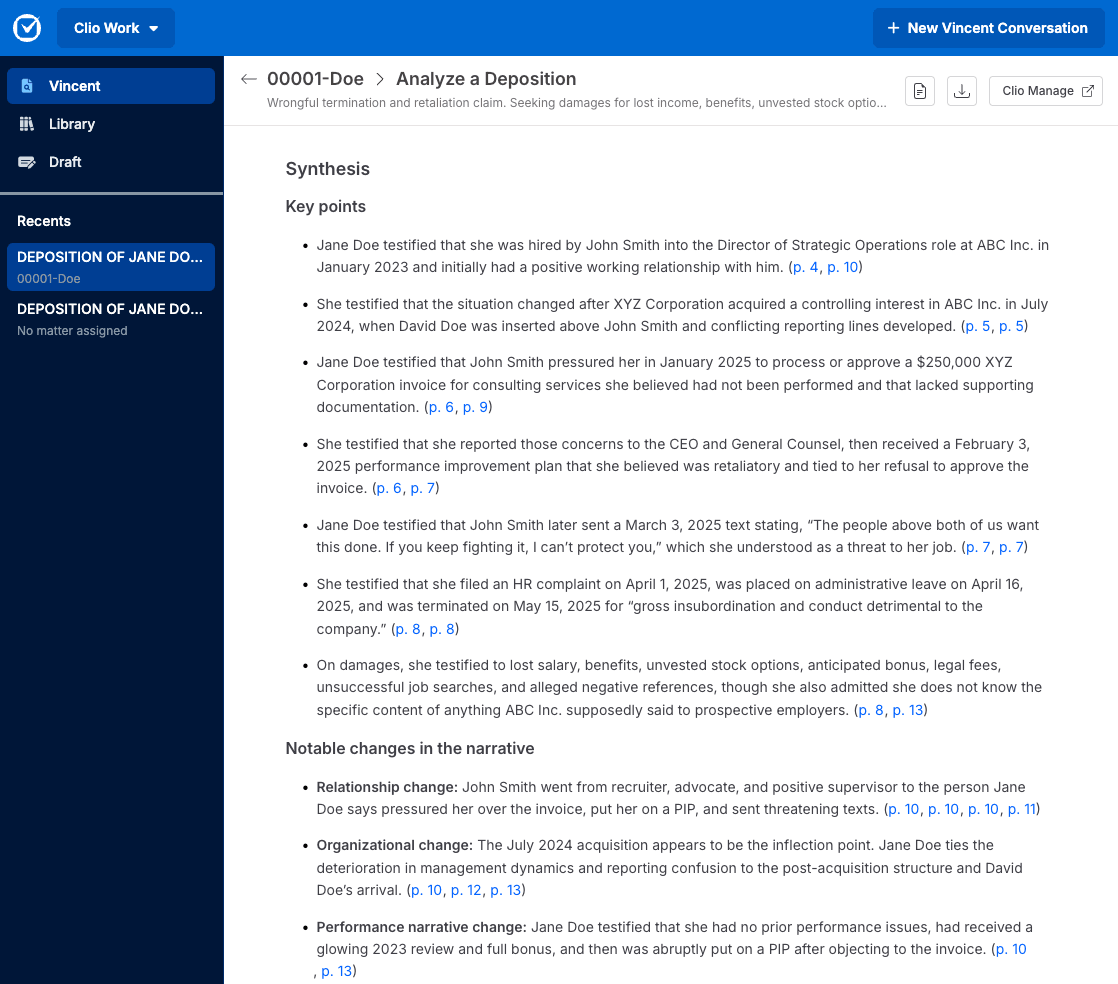
Example: From a 50-page witness transcript, a change in the witness’s account of the timing of a story is flagged, along with the most relevant sections for questioning.
Issue and theme extraction:
AI can extract claims, defenses, and credibility points to focus questioning.
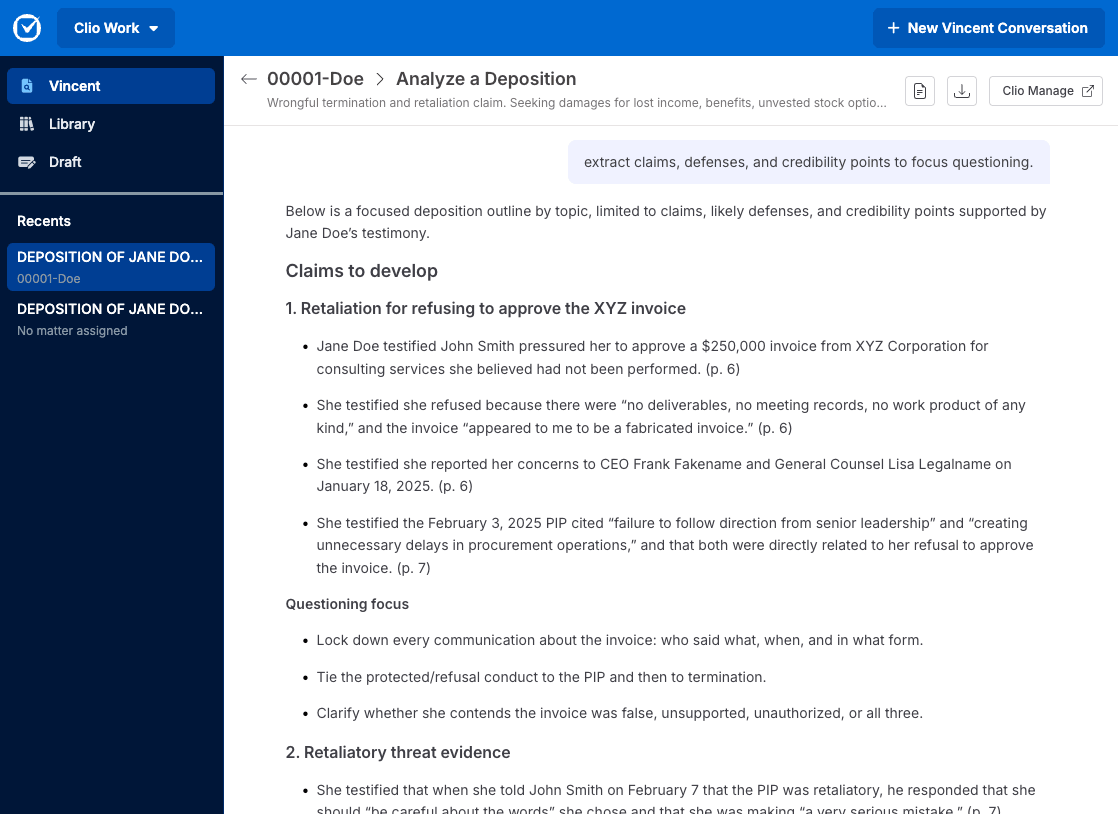
Example: In a contract dispute, key themes such as “breach of notice requirements” and “ambiguous termination clauses” are surfaced so as to prioritize the most impactful lines of questioning.
Chronologies and fact maps:
AI can determine the “who, what, where, and when” and identify gaps and inconsistencies.
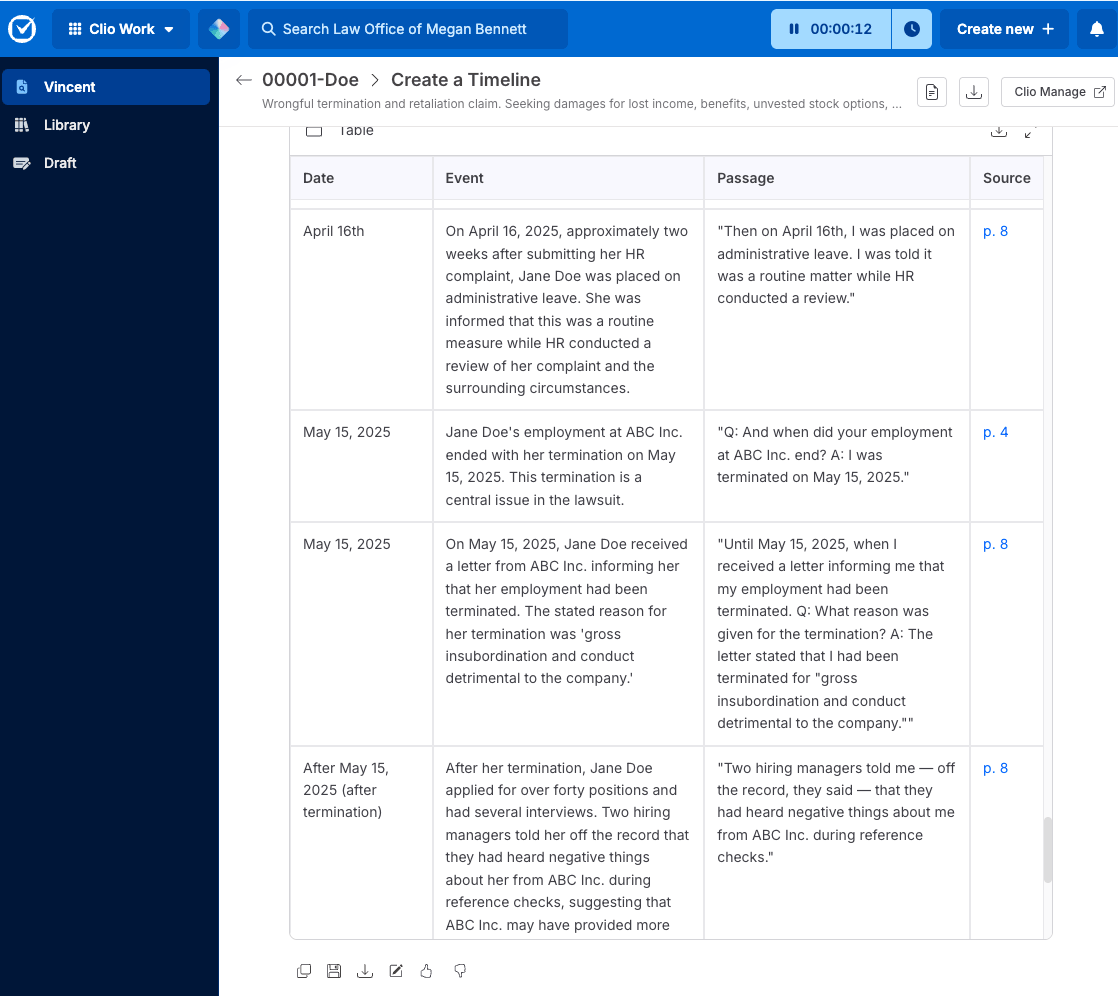
Example: A timeline reveals that the witness claims to have signed an agreement on March 5, but emails might indicate that it was sent on March 8, indicating a possible inconsistency.
Outline drafts:
AI can help create topic buckets and question threads, giving you a solid starting point.

Example: A draft outline groups questions under headings like “timeline of events,” “communications with third parties,” and “internal approvals.”
Post-deposition recap:
AI can summarize admissions, follow-ups, and action items.

Example: Following a deposition, a one-page recap noting that the witness admitted responsibility for a missed deadline. It also creates five follow-up documents and recommends three topics for further questioning.
Outlines: from blank page to lawyer-ready
Building a deposition outline is often one of the most time-consuming parts of deposition prep. It’s where scattered facts, documents, and strategy have to come together into a clear, cohesive structure.
If you’re starting from scratch, you’re likely facing the dreaded blank page. Even the most seasoned litigators find it daunting. AI can jumpstart the process by grouping topics and question threads logically, generating a draft structure.
You might think of it as a first pass: AI synthesizes your materials, suggests themes, and proposes an order based on the documents and transcripts it’s analyzed, creating a draft that attorneys can review and refine.
Here’s how an AI-backed workflow might look:
- Drafting: AI produces a starting outline with topic buckets, key issues, and potential follow-up threads.
- Editing: The attorney refines the draft to match the case theory, adds emphasis where needed, and ensures that everything aligns with witness and courtroom strategy.
- Finalizing: Building on the AI-generated draft, the attorney creates the final outline, ensuring that it’s organized, focused, and fully tailored to the deposition’s goals.
Using AI as the starting point allows lawyers to streamline the structuring phase and focus on the strategic decisions that guide the deposition.
Summaries: what “good” looks like (and what to avoid)
Similarly, writing post-deposition summaries is often time-consuming, especially when lawyers are pressed for time or juggling multiple cases. A good summary should be accurate, structured, and trace back to the source material. Each key point must include a transcript’s page-and-line citation, or a reference to a specific document (e.g., exhibit). This precision allows lawyers to quickly verify the point and pull supporting material.
Example: Instead of writing, “The witness acknowledged delays in the project timeline,” a strong summary might say: “Witness admits that the project timeline slipped by approximately two months (Transcript p. 47, lines 12-18).” Summaries like this can be used during both the prep stage and the deposition itself.
Yet lawyers often struggle to summarize at this level of detail under tight deadlines. High-level, “vibes-based” summaries may feel faster. However, they don’t have a clear connection to the underlying record and therefore require painstaking fact-checking, which slows preparation and increases the risk of errors.
This is where AI can help. By analyzing transcripts and documents, it can generate structured summaries that link each point to its source. This speeds up synthesis, improves consistency across materials, and ensures every point is verifiable, all without replacing the attorney’s careful legal review.
Get Practical on AI in Litigation
Catch every session at your own pace. Sign up to unlock the on-demand Litigator's Lounge recordings and see how AI applies to real litigation work.
Watch now
Best practices and guardrails when using AI for depositions
When using AI for deposition prep, a few simple habits can ensure that results are both reliable and defensible. Keep in mind that strong outputs depend on good inputs, clear prompts, and careful verification.
- Use trusted tools. Stick to firm-approved platforms and workflows.
- Minimize sensitive inputs. Limit sensitive information shared when using non-legal AI tools. Clio Work offers stronger protections than consumer platforms, so know when to include confidential data versus generic information in your prompts.
- Request cited outputs. Ask the AI tool to include sources when possible (e.g., transcript page/line references or exhibit IDs).
- Verify against the record. Always confirm key facts before relying on them.
- Use consistent prompts. Maintain a standard prompt template to produce repeatable, structured results.
These guardrails allow lawyers and support staff to harness AI efficiently, freeing up time for legal strategy and case analysis.
Use cases across criminal, civil, and commercial law
AI-assisted deposition prep can support lawyers across all matters, including criminal, civil, and commercial law. The tasks are largely similar: organizing facts, comparing statements, and surfacing key evidence. Applications, however, may vary by practice area:
Criminal matters
AI can compare witness statements, build event timelines, and flag credibility issues across interviews or prior testimony. This helps attorneys identify contradictions or gaps that may affect witness reliability or case strategy.
Example: AI compares a suspect’s police interview with their later testimony to identify inconsistencies about where they were on the night of the alleged offense.
Civil litigation
In document-heavy cases, AI can tie evidence to specific allegations, track admissions, and organize facts from discovery materials. This reduces the manual effort of cross-referencing hundreds or thousands of documents and ensures no key detail is overlooked.
Example: AI maps deposition testimony to internal emails and reports, showing when a company first became aware of a safety issue. It also highlights contradictory statements that strengthen or weaken claims, helping attorneys prepare targeted questioning and identify follow-up discovery needs.
Commercial disputes
AI can manage complex contract records, identify key clauses, and connect documents to specific lines of questioning. This is especially valuable in disputes involving multiple contracts, amendments, or communications across numerous stakeholders.
Example: AI links emails, contract amendments, and meeting notes to create a questioning sequence about whether notice of termination was properly given. It also flags inconsistent interpretations of contractual obligations and summarizes relevant communications to help guide deposition strategy.
Why platform-based AI matters for litigation

AI for deposition prep is most effective when lawyers connect AI directly to the matter and all its related materials. This integration allows lawyers to move from scattered inputs to a structured, prep-ready view—without juggling multiple tools or duplicating work.
Advanced platforms like Clio are successfully implementing this approach, with AI that works directly within the tools lawyers and support staff already use, boosting efficiency without compromising control over strategy and sensitive information.
Lawyers who are worried about confidentiality can rest assured: a secure, workflow-native approach provides strong protection. Using firm-approved tools and keeping information within a trusted platform helps reduce “tool sprawl,” maintain clear audit trails, and safeguard client data.
Start this week with one repeatable workflow
Maybe you’re new to AI. Maybe you’re a skeptic. Or maybe you’ve experimented with generic tools like ChatGPT and are ready to take it up a notch.
No matter where you find yourself, getting started with AI for deposition prep doesn’t have to be complicated. Begin with a single deposition packet and run a simple workflow: summary → timeline → outline. Then use the results to refine your prompt template and repeat the process across 5-10 similar matters. Over time, you’ll establish a standardized workflow that consistently produces accurate, structured, and prep-ready outputs.
Clio makes this easier by bringing AI directly into your matters and workflows, so you can build that process without duplicating work or compromising client confidentiality. See it in action—book a demo today.
Learn how to leverage AI in your legal practice with our AI for Lawyers series. Discover how AI can streamline deposition prep, all within your firm’s existing workflows.
AI for Deposition Prep FAQs
What is the best AI to summarize depositions?
The most effective AI for summarizing depositions is one that works directly within your matters and existing workflows. It should be firm-approved and designed to ensure accuracy, traceability, and security.
What is the best AI for preparing legal documents?
The right AI tool for preparing legal documents should fit your workflow, protect client data, and help maintain consistency across documents. It should keep strategic judgment firmly in the lawyer’s hands.
What can AI do during deposition prep?
AI can summarize large volumes of documents and notes, identify key themes and facts, spot contradictions or gaps in the record, and draft outline starting points for questioning based on the legal elements. Tasks that normally take hours or days can be completed in a fraction of the time, freeing attorneys to focus on strategy.
Where does AI help most in deposition prep?
Five areas: transcript and document summaries (flagging changes in a witness’s account), issue and theme extraction (surfacing claims, defenses, and credibility points), chronologies and fact maps (spotting inconsistencies between dates and documents), outline drafts (grouping questions into topic buckets), and post-deposition recap (summarizing admissions, follow-ups, and action items).
How can AI help create a deposition outline?
AI jumpstarts the blank page. It synthesizes case materials, suggests themes, and proposes a question order based on the documents and transcripts it has analyzed. The workflow has three steps: AI produces a starting outline with topic buckets and key issues, the attorney refines it to match case theory, then finalizes it with witness and courtroom strategy in mind.
What makes a good AI-generated deposition summary?
A good summary is accurate, structured, and traces back to the source material. Each key point should include a transcript page-and-line citation or a reference to a specific document or exhibit. Instead of vague claims like “the witness acknowledged delays,” a strong AI summary reads: “Witness admits the project timeline slipped by approximately two months (Transcript p. 47, lines 12-18).”
What are the best practices for using AI in deposition prep?
Five practices: use trusted, firm-approved tools and workflows; minimize sensitive inputs when using non-legal AI tools and know when to include confidential data versus generic information; request cited outputs with transcript page references or exhibit IDs; verify key facts against the record before relying on them; and use consistent prompts to produce repeatable, structured results.
How does AI help with depositions across different practice areas?
AI supports deposition prep across criminal, civil, and commercial matters with practice-area-specific applications. In criminal cases, it compares witness statements and builds event timelines to flag credibility issues. In civil litigation, it ties evidence to allegations and tracks admissions across discovery materials. In commercial disputes, it manages contract records and connects documents to lines of questioning.
How should lawyers get started with AI for deposition prep?
Start with one deposition packet and a simple workflow: summary, then timeline, then outline. Use the results to refine your prompt template, then repeat the process across 5-10 similar matters. Over time, you’ll establish a standardized workflow that consistently produces accurate, structured, prep-ready outputs. The goal is a repeatable process, not perfect outputs on the first run.
Get Practical on AI in Litigation
Catch every session at your own pace. Sign up to unlock the on-demand Litigator's Lounge recordings and see how AI applies to real litigation work.
Watch now